Green to Clean in McKinney, TX
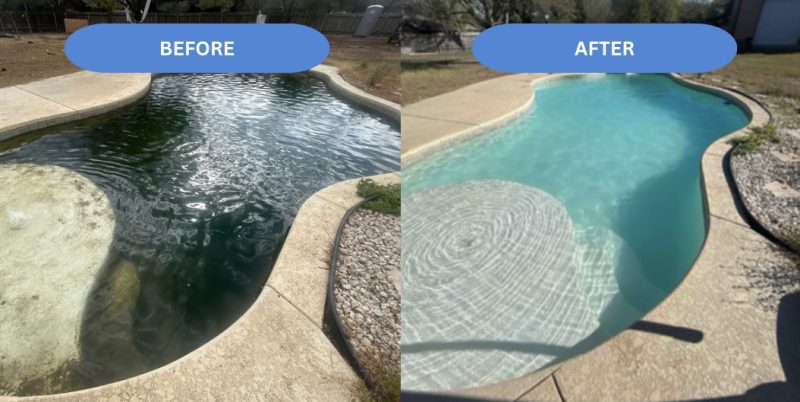
Green to clean in McKinney from a family-owned, TDLR-licensed team. We treat, brush, filter and vacuum until your pool is swimmable again, usually without draining.

Green to Clean From a Local McKinney Team
Family-owned, TDLR-licensed and rated 5.0 on Google
Green to clean is how we bring an algae-filled pool back to clear water. It doesn’t matter if the water has a light green tint or is so dark you can’t see the steps. We treat the water, brush the walls and floor, clean the filter and vacuum until the pool is swimmable again. The sooner we start, the less algae there is to fight.
Many pools clear within 24 to 72 hours. A light green pool often clears in 24 to 48 hours, a heavy bloom takes 48 to 72, and a severe one can take up to five days. Most pools never need draining, either. That matters here, because an empty pool in Texas heat can be risky for the finish.
We’re a family-owned company based in McKinney, and we’ve worked on pools here for more than ten years. We cover every McKinney ZIP code, from Eldorado and Adriatica to Trinity Falls. Owner Robert Pierce trains every technician on our routes, so the person clearing your pool knows how fast algae moves in a North Texas summer.
Is your pool green right now? Call (469) 884-4022 for a free quote, or fill out the form. We take a quick look at the pool and equipment, then give you a price. There’s no contract to sign, and we’ll tell you up front what your pool needs. Tell us how long it’s been green, and we’ll take it from there.
Is Your Pool Green? Get a Free Quote From Sparkling Clear
Why a Green Pool Can't Wait in North Texas
A green pool rarely fixes itself. Algae multiplies fast, and the longer it grows, the more chlorine, brushing and filter time it takes to clear. If you’d like the full list of causes, our guide on why a pool keeps turning green walks through them.
Algae Can Take Over in Less Than a Day
Wind carries millions of algae spores into backyard pools every day. Most of the time, chlorine kills them before they get going. Once chlorine runs low, though, some algae can turn a clear pool green in less than a day. Light and warm water speed that growth along, and a McKinney summer supplies plenty of both.
Algae also eats well here. Fertilizer, soil, dead bugs and decaying plant matter all carry phosphates and nitrates, and algae feeds on them whenever the chlorine is gone. That’s why a pool can look fine on Friday and turn green over a long weekend.
How Fall in McKinney Feeds Algae
Summer gets the blame, but fall brings its own trouble. Cedar elm and ragweed pollen keep drifting into pools until the first hard freeze. At the same time, leaves start piling up in the skimmer. All of that debris uses up chlorine, and anything that sinks to the floor becomes food for algae. Meanwhile, plenty of folks ease off on pool care once swim season ends, and that’s when algae gets its opening.
What Algae Hides Under the Surface
Algae itself usually isn’t what hurts people. The bigger risks are practical. It makes walls, steps and the floor slick, so it’s easy to slip, especially where the shallow end slopes toward the deep end. It also clouds the water, which makes it hard to see someone struggling below the surface. Finally, algae can harbor bacteria, and a pool left alone long enough can turn into a mosquito breeding ground.
How Our Green Pool Treatment Works
Every green pool is a little different, but the work follows the same order. Here’s what happens once we start:
- Test the water, including free chlorine, pH and stabilizer, so the treatment fits what’s in the pool
- Raise the chlorine to a shock level that kills the algae, and add an algaecide when the type of algae calls for it
- Brush the walls, floor, steps and corners to knock the algae loose
- Run the filter and clean it as it loads up with dead algae
- Vacuum the dead algae off the floor once it settles
- Retest and rebalance until the water is clear and swimmable
Brushing matters more than most people expect. Algae clings to walls and steps, and brushing knocks it loose so the chlorine and algaecide can reach it. After that, dead algae drifts down and settles. We give it at least two hours before vacuuming, so it comes up in the vacuum instead of clouding the water again.
Why Algae Removal Starts With a Water Test
Not every green pool is algae. Cloudy, murky green water usually is. Clear water with a green or blue-green tint, on the other hand, more often points to dissolved copper. That copper can come from corroded equipment or from certain algaecides. The difference changes the plan. A big dose of chlorine on copper-tinted water can stain plaster, so metals need a different treatment and a second test about 24 hours later.
The Three Kinds of Pool Algae
Green algae is by far the most common kind, and it’s also the easiest to control. Black algae is tougher. It grows in spots that don’t get much circulation, like deep corners. Mustard algae, also called yellow algae, often needs an algaecide made just for it.
On plaster, black spots usually get a stainless steel brush. That brush is too harsh for vinyl, and even on plaster it isn’t meant for everyday use. Copper algaecides work well on black algae, too. Still, copper can stain plaster when the water is out of balance, so it has to be used with care.
How Long Green Pool Cleanup Takes
Many pools clear within 24 to 72 hours. The timeline depends mostly on how far the algae got:
- Light green: often clear in 24 to 48 hours
- Heavy green, where you can’t see the floor: about 48 to 72 hours
- Severe, swampy water: up to five days
Stabilizer can slow things down. Cyanuric acid, or CYA, protects chlorine from the sun and works best between 30 and 50 ppm. Too much of it, though, raises the risk of algae. When stabilizer runs high, the usual fix is replacing part of the water with fresh water.
Why the Filter Sets the Pace
Chlorine kills algae, but the filter is what pulls it out of the water. Algae clogs a filter quickly, so runs get shorter and the pressure climbs. That’s why we clean the filter during the job. A worn sand bed or a torn cartridge can stall a green pool recovery. If we find one, we’ll show you and explain the fix once the water is clear.
Do You Need to Drain a Green Pool?
Usually not. Most green pools clear with chlorine, brushing, filtering and vacuuming while the water stays in. Draining is a last resort for extreme cases. In Texas heat, an empty pool can be risky for the finish.
There’s a structural risk, too. Where the water table is high, groundwater pushes up on the underside of a pool shell. If it rises high enough, an empty pool can even lift out of the ground. So we treat in place, and we’ll tell you straight if your pool is the rare exception.
What Affects the Cost of Green Pool Cleanup
We don’t post a flat price for green pool cleaning, because no two green pools take the same work. Your price mostly comes down to these:
- Pool size, since more water takes more chlorine to treat
- How green it is, from a light tint to swampy water you can’t see into
- The type of algae, since black and mustard algae take more brushing and treatment
- How well the filter and pump are working
- Water chemistry, such as stabilizer that has climbed too high
We take a quick look at the pool and equipment, then give you a price before we start. The quote is free, and there’s no contract to sign.
Signs Your Pool Needs Green to Clean
Some pools go green all at once. Others give you a warning first. Call us if you notice any of these:
- The water has a green tint, or it has turned cloudy and dull
- You can’t see the main drain or the bottom of the deep end
- The walls or steps feel slippery
- Dark spots keep showing up in the corners
- Filter pressure climbs much faster than it used to
- You shocked the pool, and it’s still green a few days later
- You just bought a home with a pool that sat untended
What Green to Clean Doesn't Cover
Green to clean gets the water clear. It’s one of our specialty services, so it’s priced as its own job. A few related jobs sit outside it:
- Equipment problems behind the algae, like a pump that won’t hold prime, which our pool repairs team prices before any work starts
- A pool filter sand change when the sand in your filter is worn out
- Deep pool filter cleaning for cartridge and DE filters
- Ongoing care after the water clears, which is what weekly pool service is for
What to Do Before Our Tech Arrives
If your pool turned green overnight, a few simple steps help until we get there:
- Keep everyone out, including the dog, until the water is clear and you can see the floor
- Leave the pump running so the filter keeps working
- Empty the skimmer and pump baskets, because full baskets choke the flow and make the pump work harder
- Hold off on copper algaecides until you know what’s causing the color, since copper can stain plaster
- Don’t drain the pool
If you test the water yourself, write down free chlorine, pH and stabilizer. Those three numbers tell us a lot before we even open the gate.
Keeping It Clear Afterward
Once the pool is clear, the goal is simple. Never let the chlorine hit zero again. Keep free chlorine between 2 and 4 ppm and pH between 7.4 and 7.6. Brush the walls on a regular basis, since it’s far easier to prevent algae than to remove it. Then keep leaves and grass clippings out of the water, because debris on the floor feeds the next bloom.
Why McKinney Families Call Sparkling Clear About Green Pools
Sparkling Clear is family-owned and based in McKinney. We’ve worked on pools around town for more than ten years, in every ZIP from 75069 to 75072. Owner Robert Pierce trains every technician on our routes, and in our reviews you’ll see folks call him Bob.
We hold TDLR Residential Appliance Installation Contractor License #1066, and Robert holds installer license #448687. You can look up both on the TDLR license search. That matters on a green pool more than you’d think. Sometimes the algae is a symptom of a pump problem, and Texas requires a TDLR license for pool electrical work. We can find the problem and price it before any work starts, so you’re not waiting on a second company.
We’re rated 5.0 on Google. If y’all have a question while we’re working on your pool, call us. Robert still answers the phone.
How to Get Started With Green to Clean
- Call (469) 884-4022 or fill out the form on this page.
- We take a quick look at the pool and equipment, then give you a price.
- We treat the water, brush, clean the filter and vacuum until the pool is swimmable.
- Once it’s clear, you decide what comes next.
On the first visit, we test the water before adding anything. If the green turns out to be copper instead of algae, or the pump isn’t moving water, you’ll hear it from us, along with what it takes to fix.
Green to Clean FAQs for McKinney Homeowners
Straight answers to the questions we hear most about clearing a green pool. If yours isn’t here, call (469) 884-4022.
Questions About Clearing a Green Pool
Many pools clear within 24 to 72 hours. Light green water often clears in 24 to 48 hours, a heavy bloom takes 48 to 72, and a severe one can take up to five days. Sparkling Clear keeps treating, brushing, filtering and vacuuming until the water is swimmable.
Usually, yes. Most green pools clear in place with chlorine, brushing, a clean filter and vacuuming. Draining is a last resort. In Texas heat an empty pool can be risky for the finish, and a high water table can push an empty shell upward. We'll tell you if yours is an exception.
Rarely. Some algae can turn a clear pool green in less than a day, but clearing takes longer. Chlorine has to kill the algae, the filter has to catch it, and the dead algae has to settle before vacuuming. Even a light green pool usually needs 24 to 48 hours.
A high dose of chlorine, called shocking or superchlorinating, paired with hard brushing. Brushing breaks the algae loose so the chlorine can reach it. Check pH first, because chlorine works noticeably better at 7.5 than at 7.8. Black and mustard algae may also need an algaecide made for them.
Test the water, shock it, brush every surface, keep the filter running and clean, then vacuum the dead algae once it settles. Then rebalance and retest until free chlorine is back between 2 and 4 ppm. That's the order Sparkling Clear follows on every green to clean job.
More Green Pool Questions From McKinney Owners
It depends on the pool's size, how green it is, the type of algae and how well the filter and pump work. Sparkling Clear doesn't use a flat rate. We take a quick look, then give you a free quote before any work starts.
It's still fixable, but a severe bloom can take up to five days. Black algae grows in low-circulation spots like deep corners, so it needs heavy brushing, often with a stainless steel brush on plaster, plus the right algaecide. In most cases, Sparkling Clear treats it without draining.
Yes. Free chlorine, pH and stabilizer tell you how much chlorine the job needs. Clear water with a green tint often means copper, not algae, and shocking copper can stain plaster. No reliable kit? Sparkling Clear tests it on the first visit.
Most green pools clear with filtering, brushing and vacuuming. Flocculant clumps fine particles so they sink, but the pump stays off 12 to 24 hours while they settle before vacuuming to waste. It can help with stubborn cloudiness, but it doesn't kill algae on its own.
Yes. Dead algae sinks to the floor, so we vacuum it out after it settles for a couple of hours. Algae also clogs filters fast, so Sparkling Clear cleans the filter as part of the job. We also treat, brush and rebalance the water.