Pool Light Installation in McKinney, TX
Pool light installation in McKinney from a family-owned, TDLR-licensed team. We swap halogen lights for LED, add color-changing lights and replace fixtures that fail.

Pool Light Installation From a Local McKinney Team
Family-owned, TDLR-licensed and rated 5.0 on Google
Pool light installation puts a new underwater light in your McKinney pool, and pool light replacement swaps an old one for something better. With an LED upgrade, the halogen light comes out and an LED goes in. It uses far less power and lasts longer. We also add color-changing lights, and we handle pool light repair when a fixture fails.
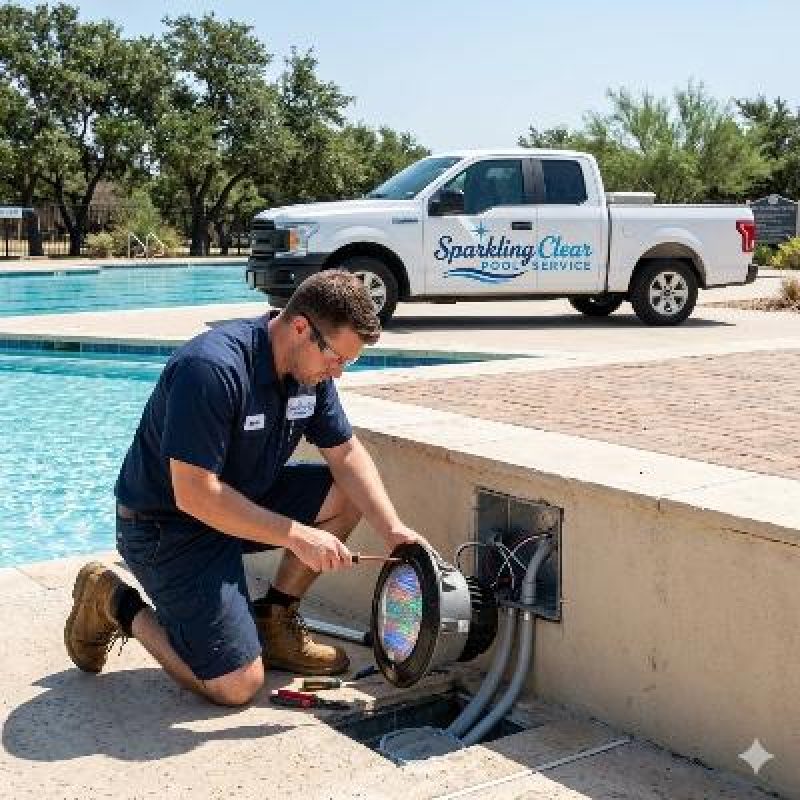
Every job starts with a look at your whole equipment pad, including the electrical supply that feeds the light. Next, we explain your options and the cost before any work starts. Then your tech removes the old fixture, wires in the new one and tests it. If your pool has automation, we connect the light to it and show you how everything works.
A pool light is electrical work that sits in water, so a licensed tech should handle it. A damaged underwater light can charge the water around it, so this is no place for guesswork. Sparkling Clear holds a TDLR license for this kind of work, and owner Robert Pierce trains every technician on our routes. We’re family-owned, based right here, and we’ve worked on McKinney pools for more than ten years.
We cover every McKinney ZIP code, from Eldorado and Adriatica to Stonebridge Ranch. Call (469) 884-4022 for a free quote, or fill out the form. We’ll take a quick look at your pool and lights, then give you a price. There’s no contract to sign, and you’ll know the cost before we start.
Ready to Light Up Your Pool? Get a Free Quote From Sparkling Clear
Why Good Pool Lights Matter After Dark in McKinney
Summer afternoons in McKinney run hot, so plenty of families swim after the sun goes down. That’s when good pool lighting earns its keep. It shows swimmers the steps, the benches and the spot where the shallow end drops away.
Seeing the Steps and the Bottom at Night
Steps and benches need to be easy to see, both from the deck and from inside the water. In the dark, a swimmer climbing out can misjudge the edge of a step. The floor matters too. A good rule is to swim only when you can clearly see the bottom of the pool, and after sunset that depends on your lights. A dark pool also hides trouble, since it’s hard to tell whether the water is clear before someone jumps in.
Storms play a part as well. Spring storms roll through McKinney from March into May, and they can knock the power out. When that happens in the evening, the pool goes dark with people still in it. So the safe habit is to clear the water at the first sound of thunder, before the lights ever flicker.
Is a Loose Pool Light Dangerous?
It can be, because a damaged pool light can shock you. The underwater light fixture is one of the most serious shock hazards in any pool. Water and wet skin carry current easily, and a bad fixture can charge the water around it. If a swimmer then grabs a metal ladder, current can run through them.
That’s why a light should sit snug in its niche, with no gap between the fixture and the pool wall. If yours hangs loose, fogs up with water or trips the GFCI, keep it off. Then call a licensed tech before anyone swims near it.
What Wears Out a Pool Light
Water chemistry takes a toll over time. Corrosive water, usually from low pH, can slowly dissolve metal parts in a pool, and light fixtures are on that list. Stainless steel fixtures contain iron, so corrosion can show up as reddish-brown stains or tinted water. Lenses and seals also wear out, so a tech replaces them along with burned-out bulbs.
Mixed metals add to the wear. When a pool has a heater with a copper heat exchanger plus other metals in the plumbing and light fixtures, galvanic corrosion can set in and discolor the metal parts.
How Our Pool Light Installation Works
Every install follows the same steps, whether it’s a single LED swap or a set of new color-changing lights:
- Look over the equipment pad, the plumbing and the electrical supply that feeds the light
- Explain your options and the cost before any work starts
- Shut off the power, then remove the old fixture
- Wire in the new light and seat it snugly in the niche
- Test it, and program the colors on color-changing models
- Connect it to your automation, if you have it
- Walk you through how to use it
We install Hayward, Pentair, Jandy and Zodiac equipment. That way the new light can match the brand already on your pad.
Wet-Niche vs. Dry-Niche Pool Lights
Underwater pool lights come in two basic designs. A wet-niche light sits in a niche in the pool wall, with pool water all around it. With the water still in, a tech can lift it out of the niche and lower it to the pool floor.
A dry-niche light works differently. It sits behind a waterproof window in the pool wall, and the tech reaches it from outside the pool. Since the two designs come apart in different ways, we check which kind you have during the free quote.
The Safety Checks Behind Every Light
Underwater lights fall under the electrical code’s rules for pools, NEC Article 680. Those rules require grounding and bonding for the light, which ties every metal part within reach to the same ground potential. They also call for GFCI protection on underwater lights that run at more than 15 volts. A GFCI cuts the power when it senses about 5 milliamps leaking out of the circuit.
Bonding covers more than the light. The code also calls for bonding the ladders, handrails and metal in the pool shell, so nothing within reach sits at a different voltage.
Older pools can miss some of this. A pool older than 30 years may not have GFCI protection on its light circuit at all. So before we install anything, we check the electrical supply that feeds the light. If something needs work, we explain it and the cost before we start.
LED Pool Lights vs. Halogen
An LED pool light uses far less power than a halogen light, and it lasts longer. That means fewer burned-out bulbs and fewer trips into the niche over the years. When an old halogen light finally quits, it’s a natural time to make the switch.
LED also opens the door to color. With a color-changing LED, you can set the mood for the night. Plus, a light that lasts longer means fewer evenings with a dark pool.
Color-Changing Pool Lights
A color-changing light turns the pool into the center of the backyard after dark. You can pick one calm color for a quiet night, or cycle through several when friends come over. After install, we program the colors so they’re ready the first evening.
If you’d like to run the colors on a schedule or from your phone, that’s where pool automation comes in. We connect new lights to the system you already have, so the light runs with the rest of your equipment.
Signs You Need Pool Light Repair or Replacement
Call us if you notice any of these:
- The light won’t come on at all
- The GFCI or breaker trips when you switch the light on
- Water or fog shows up inside the lens
- The fixture hangs loose, or there’s a gap between it and the niche
- A crack runs across the lens
- Reddish-brown stains or rust show up around the light
- The light looks much dimmer than it used to
Repair the Light or Replace It?
Some problems are small. A tech can replace a burned-out bulb, a cracked lens or a worn seal on its own, then tighten the light back into the pool wall. Other times the fixture itself has failed, and a new light makes more sense. If an old halogen fixture fails, that’s a good moment to move to LED.
Either way, we find the cause first and give you a price before any work starts. And if a repair doesn’t make sense, we’ll say so and walk you through replacement options.
What Affects the Cost of Pool Light Replacement
Every pool is different, so we price each job after a quick look. These are the things that move the number:
- How many lights you’re adding or replacing
- White LED or color-changing models
- Whether you have wet-niche or dry-niche fixtures
- The condition of the wiring and the electrical supply that feeds the light
- Whether the old fixture comes out cleanly or has corroded in place
- Whether the new light ties into your automation
You’ll see the price before we start, and there’s no contract to sign.
What Pool Light Installation Doesn't Cover
Lights are one part of your equipment. A few related jobs have their own pages:
- New pumps, which our pool pump installation team handles
- New heaters, covered under pool heater installation
- Broken pumps, filters and heaters, which go to our pool repairs team
- Ongoing water care, which our weekly plans cover
Planning more than a light? Our pool equipment installation page covers every install we do.
How to Keep Your Pool Lights Working
A few easy habits help your lights last longer and keep swimmers safe:
- Keep the water balanced, with pH between 7.4 and 7.6, since low pH water can corrode metal light parts
- Check now and then that each light sits snug in its niche, with no gap around the edge
- Leave a light off if it fogs up, hangs loose or trips the GFCI, and call a licensed tech
- Watch for reddish-brown stains near a light, since they can be an early sign of corrosion
- Get everyone out of the water at the first sound of thunder
- Leave the fixture closed, because any work on it starts with the power off and belongs with a licensed tech
A weekly look at the water helps too. Balanced water protects the light, along with the rest of the metal in your pool.
Why McKinney Homeowners Trust Sparkling Clear With Pool Lights
Sparkling Clear is a family-owned company based in McKinney, and we’ve worked on pools here for more than ten years. Owner Robert Pierce trains every technician on our routes. Customers know him as “Bob” in our reviews, and he still answers the phone.
Pool light work is electrical work, and it calls for a license. We hold TDLR Residential Appliance Installation Contractor License #1066, and Robert holds installer license #448687. You can check both on the TDLR license search. We’re also fully insured. Every light job starts with the electrical supply, because a light can work fine and still be unsafe.
Our Google rating is 5.0. And if y’all ever have a question about your new light, just call (469) 884-4022.
How to Start Your Pool Light Installation
- Call (469) 884-4022 or fill out the form on this page.
- We take a quick look at your pool, lights and electrical supply, then give you a price.
- Pick your fixture, whether that’s a white LED or a color-changing model.
- We install it, test it and show you how it works.
If your current light just stopped working, start the same way. We’ll find the cause first, then give you a price before any work starts.
Pool Light Installation FAQs for McKinney Homeowners
Straight answers to the questions we hear most about pool light installation and repair. If yours isn’t here, call (469) 884-4022.
Questions About New Pool Lights
It depends on the job. The number of lights, white or color-changing LED models, wet-niche or dry-niche fixtures and the state of the wiring all change the price. Sparkling Clear takes a quick look at your pool, lights and electrical supply, then gives you a price before any work starts.
Yes. Sparkling Clear swaps halogen lights for LED, adds color-changing lights and replaces failed fixtures in pools that are already built. Each underwater light sits in a niche in the pool wall, so the free quote starts with a look at your lights and the electrical supply that feeds them.
Usually, yes. An LED pool light uses far less power than halogen and lasts longer, so you'll replace it less often. LED also opens the door to color. The easiest time to switch comes when your old halogen light burns out. Sparkling Clear handles the swap.
Yes. Sparkling Clear replaces old fixtures with color-changing LED lights and programs the colors after install. If your pool has automation, we connect the new light to it so it runs with the rest of your equipment. We check the electrical supply first and price the job before starting.
Sparkling Clear looks over your equipment pad and electrical supply first, then explains your options and the cost. On install day, the tech shuts off the power, removes the old fixture, wires in the new light, tests it and connects it to any automation you have. Then we walk you through it.
Questions About Pool Light Repair and Safety
Often, yes. A tech can lift a wet-niche light out of its niche and lower it to the floor with the water still in. A dry-niche light sits behind a waterproof window, and the tech reaches it from outside the pool. Sparkling Clear checks which kind you have.
Some do. Pool light work is electrical work in water, and the state requires a TDLR license for it. Sparkling Clear holds TDLR Residential Appliance Installation Contractor License #1066, and owner Robert Pierce holds installer license #448687. Both are listed on the TDLR website.
Harder than it looks. The underwater light is one of the most serious shock hazards in a pool. The power has to be off, the fixture has to seat right in its niche, and lights over 15 volts need GFCI protection. This work belongs with a licensed tech like Sparkling Clear.
It could be a burned-out bulb, a tripped GFCI or breaker, or water inside the fixture from a worn seal. A GFCI trips when it senses current leaking, so don't keep resetting it. Leave the light off and call Sparkling Clear. We find the cause and price the fix first.
Yes, if it runs at more than 15 volts. The pool electrical code, NEC Article 680, calls for GFCI protection on those lights. It cuts power when it senses about 5 milliamps leaking. Pools older than 30 years may not have it, so Sparkling Clear checks the electrical supply first.