Pool Filter Cleaning in McKinney, TX
Pool filter cleaning in McKinney from a family-owned, TDLR-licensed team. We clean cartridge, DE and sand filters to keep your water clear and moving.

Pool Filter Cleaning From a Local McKinney Team
Family-owned, TDLR-licensed and rated 5.0 on Google
Pool filter cleaning gets out what a quick hose-off leaves behind. Your filter traps the dirt, oils and fine particles that would otherwise cloud the water. As that load builds, the pressure gauge climbs and less water makes it back to the pool. A full cleaning resets the filter, so it can do its job again.
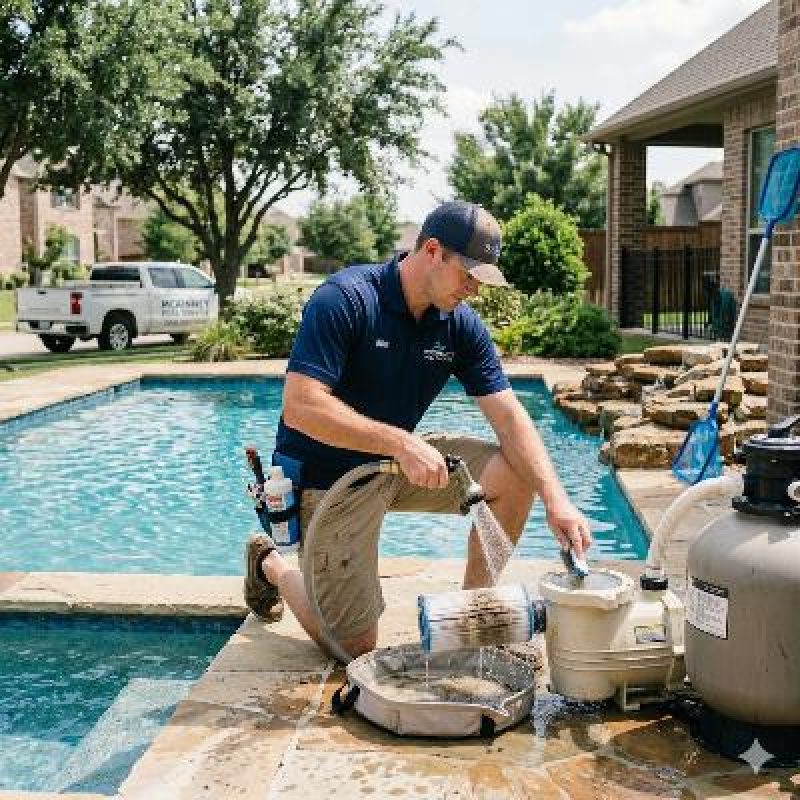
Sparkling Clear works on all three filter types. We pull cartridges to hose them off and soak them when needed, clean and recoat DE grids, and backwash sand filters when the gauge calls for it. Both of our weekly plans include a full filter cleaning twice a year. If your filter needs more than that, you can add a deep filter cleaning to either plan.
Local water makes this job bigger than it looks. McKinney’s hard water leaves calcium in cartridge pleats and on DE grids, and spring pollen packs them tight. We’ve worked on pools here for more than ten years, from Eldorado to Trinity Falls. So we know how fast a filter loads up once the oaks start dropping pollen. Then summer swimmers add sunscreen and body oils on top.
Want to know where your filter stands? We cover every McKinney ZIP code. Call (469) 884-4022 for a free quote, or fill out the form. We take a quick look at the pool and equipment, then give you a price. There’s no contract to sign, and a clean filter takes real strain off your pump.
Ready for a Cleaner Filter? Get a Free Quote From Sparkling Clear
Why Pool Filter Cleaning Matters for McKinney Pools
Your filter and pump work as a team. Circulation moves the water, while the filter pulls out the particles that make it cloudy. It also catches contaminants that help bacteria and algae grow. Once the filter clogs, both jobs suffer, and before long the water shows it.
Hard Water Leaves Calcium in the Filter
As pool water evaporates in summer heat, the minerals stay behind. That’s why calcium keeps climbing in a McKinney pool, even when nobody adds any. When calcium, pH and alkalinity all run high, the water starts to scale. Scale is the same white crust you see at the tile line, and it forms inside filters too.
In a cartridge, calcium hardens in the pleats. On a DE filter, minerals and oils clog the grid cloth, and old DE sticks to it instead of washing off. Either way, water has a harder time getting through, so pressure rises and flow drops. High pH and high calcium can also turn the water cloudy on their own.
Spring Pollen and Summer Swimmers Load It Up
Every spring, oak pollen drifts onto McKinney pools from late March into early May, and most of it ends up in the filter. Cedar elm and ragweed add another round in the fall. Then summer brings swimmers, along with sunscreen, lotion and body oils. Those oils coat cartridge pleats and grid cloth, and a garden hose alone won’t get them out.
Why Is My Pool Water Cloudy? Start at the Filter
Around McKinney, the answer to that question usually starts at the filter. The most common causes are poor filtration, weak circulation and off-balance water, and often all three show up together. So the fix starts at the equipment pad. Clean the filter, get the flow back up, then balance the water.
Sometimes the water stays hazy even after the filter is clean, the flow is right and the chemistry checks out. In that case, tiny suspended particles are the likely cause, and a clarifier can help the filter catch them. Early algae clouds water too, so a low chlorine reading deserves a closer look.
How Our Pool Filter Cleaning Service Works
Each filter type needs its own method, but every job starts with safety. A pool filter runs under pressure, so the pump goes off and the air relief valve opens before any clamp or lid comes loose. Skip that step, and the lid can separate with real force. After a cleaning, the gauge reading becomes your new starting pressure, and that number tells you when the next one is due.
Cartridge Filter Cleaning
Cartridge filters don’t backwash. Instead, the cartridges come out of the tank for a thorough hosing, pleat by pleat. Most cartridges run until the gauge reads about 10 psi over the clean starting pressure. Pentair’s filter cleaning guide uses that same 10 psi signal for its cartridge filters.
When hosing isn’t enough, the cartridge needs a soak. Oils come out first with a degreasing filter cleaner. After a good rinse, calcium comes out with an acid-based cleaner, and the order matters. If the acid goes on first, it can set the oils into the fabric. Before the lid goes back on, check the O-ring for wear and lube it as needed, since a worn one can leak water or let air into the filter.
DE Filter Grid Cleaning
A DE filter uses diatomaceous earth, a fine white powder, as its filter media. The powder coats cloth-covered grids and traps the smallest particles of any pool filter. When pressure climbs 8 to 10 psi above the starting reading, it’s time to backwash. After every backwash, fresh DE goes back in to recoat the grids.
Backwashing doesn’t get everything off the grids, though. Over time, oils and minerals work into the cloth, and that’s when the grids come out for a full cleaning:
- Spray each grid down and check the cloth for tears or holes
- Soak the grids in a filter cleaner that cuts oils, then rinse
- Use an acid-based cleaner only if calcium has built up, then rinse again
- Put the grid assembly back together and recoat it with fresh DE
The amount of DE matters. Too little lets oils clog the cloth, and too much can bridge the gaps between grids. Wear a dust mask when you handle the powder, too, because breathing DE dust over time can harm your lungs.
Sand Filter Cleaning
A sand filter cleans out with a backwash, which reverses the flow and flushes trapped dirt to waste. The rule is the same 8 to 10 psi rise over the starting pressure. Don’t backwash on a set schedule, though. Sand catches finer particles as it loads up, so backwashing too early can leave the water dull.
When calcium or oils cake the sand bed, a sand cleaner soak can break it loose. Sand that’s worn out or packed into clumps needs a pool filter sand change, which is a separate job.
How Often to Clean a Pool Filter in McKinney
Most McKinney pools need a full filter cleaning twice a year, and both of our weekly plans include two. Between those cleanings, the pressure gauge decides. Backwash or clean when it reads 8 to 10 psi above your clean starting pressure, and use 10 psi as the mark on most cartridge filters.
Some filters hit that mark sooner. A heavy pollen spring, a summer of pool parties or a run of storms can load a filter fast. On the other hand, a covered pool with few trees nearby may go longer. Either way, the gauge tells you more than the calendar ever will.
Signs Your Pool Filter Needs Cleaning
Your filter usually tells you before the water does. Watch for these signs:
- The gauge reads 8 to 10 psi higher than it did right after the last cleaning
- Return jets push less water than they used to
- Water looks dull or hazy even though the chemistry tests fine
- The skimmer pulls weakly, so leaves sit on the surface longer
- Oak pollen season or a big storm just rolled through
- Algae showed up recently, since it loads a filter quickly
What Affects the Cost of Pool Filter Cleaning
We can’t post one flat price, because no two filters are alike. These are the things that move the number:
- Filter type, since DE grids need fresh DE and cartridges may need a soak
- Size, because a large four-cartridge filter takes longer than a single one
- Buildup, as heavy calcium or oil calls for a degreaser and an acid-based cleaner
- Time since the last cleaning
Both of our weekly plans are part of our pool cleaning options, and each one includes two filter cleanings a year. Full Service starts at $189 a month, and Chemical-Only starts at $100. You can read more about weekly pool service, or add a deep filter cleaning to either plan whenever your filter needs it.
What a Filter Cleaning Won't Fix
A cleaning takes care of dirt, oils and buildup. If the filter itself has damage, that’s a different job:
- Cracked tanks, leaking lids, broken laterals or pressure that stays high after a cleaning call for pool filter repair
- Torn cartridges or grids need new elements, and an old, worn-out filter may need pool filter installation
- A green pool needs our green to clean treatment first, because algae will clog a fresh filter fast
If a cleaning turns up a problem, we show you what we found. Then we give you a price before any work starts.
How to Keep Your Filter Cleaner Between Cleanings
A few simple habits stretch the time between cleanings and help the water stay clear:
- Write down the gauge reading right after a cleaning, so you know your starting pressure
- Empty the skimmer and pump baskets often, since full baskets choke the flow
- Keep chlorine in range, because algae loads a filter quickly
- Hold pH, alkalinity and calcium in balance to keep scale out of the media
- Run the pump long enough to filter the whole pool more than once a day, since one turnover only filters about 63% of the water
- Leave chlorine tablets out of the skimmer, because chemicals fed in ahead of the filter can shorten its run
- Turn off the pump and open the air relief valve before you open the filter yourself
- If you soak a cartridge at home, use the degreaser before any acid cleaner
Between full cleanings, a quick rinse with a garden hose helps a cartridge, too. Still, a hose won’t touch calcium or baked-in oils, so the twice-a-year cleaning still matters.
Why McKinney Homeowners Trust Sparkling Clear
Sparkling Clear is a family-owned company based right here in McKinney, and we’ve worked on local pools for more than ten years. Owner Robert Pierce trains every technician on our routes. Customers know him as “Bob” in our reviews, and he still answers the phone.
We hold TDLR Residential Appliance Installation Contractor License #1066, and Robert holds installer license #448687. You can look up both on the TDLR license search, and we’re fully insured. That license matters when a filter cleaning turns up a pump or heater problem on the same pad. We price the fix first, and we can usually handle it the same or next day, depending on the season.
Our Google rating is 5.0. If y’all have a question about your filter or your gauge, give us a call.
How to Book Pool Filter Cleaning
- Call (469) 884-4022 or fill out the form on this page.
- We take a quick look at the pool and equipment, then give you a price.
- Pick a weekly plan with two cleanings a year, or add a deep filter cleaning.
- We clean the filter, and your water starts moving freely again.
If the cleaning turns up a torn cartridge or a cracked part, you’ll hear about it before any work starts. And if the water has already turned green, we’ll treat the algae first, then get the filter back on track once the water is clear.
Pool Filter Cleaning FAQs for McKinney Homeowners
Straight answers to the questions we hear most about pool filter cleaning. If yours isn’t here, call (469) 884-4022.
Questions About Filter Cleaning Cost and Timing
It depends on the filter type, its size and how much calcium or oil has built up. In McKinney, Sparkling Clear's weekly plans start at $100 a month, and every plan includes two filter cleanings a year. You can add a deep cleaning to any plan, priced after a quick look.
Most McKinney pools need a full cleaning about twice a year. In between, clean or backwash whenever the gauge climbs 8 to 10 psi above its clean starting pressure. Heavy pollen or summer use can bring that sooner. Sparkling Clear's weekly plans include two full cleanings a year.
Check the pressure gauge first. If it reads 8 to 10 psi above its reading after the last cleaning, the filter is due. Low return flow, a skimmer that barely pulls and dull or cloudy water are other signs. A dirty filter is a common cause of cloudy water.
Yes. Cartridges and DE grids are meant to go back in after a cleaning, and a good filter cleaner can stretch their life. They don't last forever, though. A torn cartridge or torn grid cloth lets dirt through, and no cleaning fixes that. Those parts need replacing.
Start with a degreasing filter cleaner to pull out oils, sunscreen and lotion, then rinse well. If calcium is still crusted in the pleats, follow with an acid-based filter cleaner. Never use the acid first, because it can set the oils into the fabric. Follow the label and the filter maker's instructions.
More Filter Questions From McKinney Owners
Go by the pressure gauge. Note the reading after a cleaning, then clean or backwash when it rises 8 to 10 psi. Backwashing sand on a schedule can hurt clarity, since the bed never loads enough to catch the finest particles. Save the calendar for twice-a-year full cleanings.
Both, at different times. Backwash whenever pressure climbs 8 to 10 psi over the starting reading, then add fresh DE. Backwashing doesn't remove everything, so the grids also need a full degreaser cleaning. Sparkling Clear does that during the two cleanings in our weekly plans.
Use the amount on your filter's label, since it depends on filter area. It's usually about 2 ounces of DE per square foot of filter area. Too little lets oils clog the grid cloth, and too much can bridge between grids. Wear a dust mask when pouring it.
Several things shorten runs. Algae and heavy pollen load a cartridge fast. A pump too big for the filter drives dirt deep into the pleats. Chlorine tablets in the skimmer shorten runs too. For an undersized filter, pool filter installation may be the real fix.
Often, yes. Poor filtration and weak flow are common causes of cloudy water, so cleaning the filter comes first. Then balance the water. If it's still hazy, a clarifier or an algae treatment may be next. Call Sparkling Clear at (469) 884-4022.