Pool Filter Installation in McKinney, TX
Pool filter installation in McKinney from a family-owned, TDLR-licensed team. We fit cartridge, DE and sand filters sized to your pump and pool.

Pool Filter Installation From a Local McKinney Team
Family-owned in McKinney, TDLR-licensed and rated 5.0 on Google
Pool filter installation means taking out a filter that’s cracked, worn out or the wrong size and putting in one that matches your pump and pool. Your filter catches the dirt, pollen and algae spores the pump pulls in, and everything else on the pad depends on it. A filter that’s too small for the pump lets dirt slip through and wears out early.
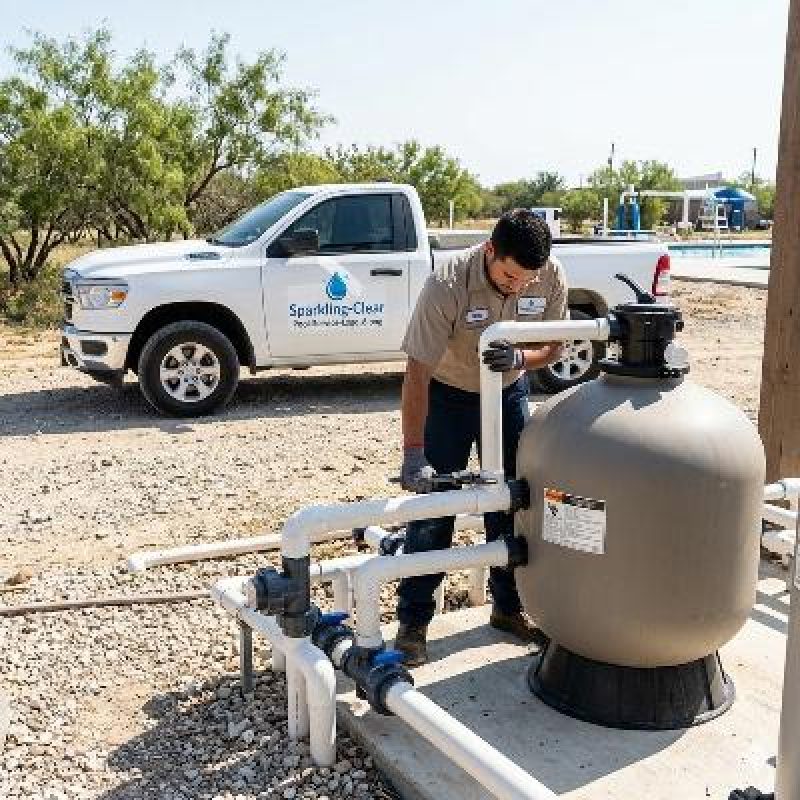
Every install starts with a look at your whole equipment pad, including the pump, the plumbing and the gauge readings. Then we walk you through cartridge, DE and sand options and explain the cost before any work starts. We install Hayward, Pentair, Jandy and Zodiac equipment, then test flow, pressure and priming before we leave. You’ll also get a quick walkthrough of the new valve and gauge.
Local know-how matters here. February 2021’s winter storm cracked pool equipment all over Texas, and our hard water leaves calcium in cartridge pleats and on DE grids year after year. Spring oak pollen loads filters up, too. We’ve worked on pools in every McKinney ZIP code for more than ten years, from Eldorado to Tucker Hill, so we know what our weather and water do to a filter.
Ready for a filter that fits? Call (469) 884-4022 for a free quote, or fill out the form. We’ll take a quick look at your pool and equipment, then give you a price. There’s no contract to sign, and owner Robert Pierce still answers the phone if you have questions.
Ready for a New Pool Filter? Get a Free Quote From Sparkling Clear
Why Filters Wear Out Faster in McKinney Backyards
A pool filter sits outside all year and works every hour the pump runs. In North Texas, it also has to ride out freezing nights, hard water and heavy spring pollen.
What the 2021 Freeze Did to Equipment Pads
According to the National Weather Service, DFW stayed at or below freezing for 139 straight hours in February 2021. On February 16, it hit 2 below zero.
That week, pool equipment cracked all over Texas. Water expands as it freezes, and a filter tank full of still water gives that pressure nowhere to go. That’s why running the pump through freezing nights was the standard advice. If your filter made it through, it’s still worth a close look for hairline cracks around the tank and valve.
How Hard Water Builds Up Inside a Filter
When pool water evaporates, the calcium stays behind. Over time, it can form scale inside filters, heaters and pipes, especially when pH and alkalinity run high. In a cartridge, that calcium settles into the pleats. On DE grids, it builds up on the cloth.
Then spring adds oak pollen, which falls from late March into early May. Regular cleanings handle most of that load. When the pressure stays high even after a good cleaning, though, the filter itself may be done.
What Our Pool Filter Installation Includes
A filter works as part of a system, so we check everything it connects to before we pick one. Here’s how a typical install goes:
- Inspect the pad, the plumbing and the electrical supply for the pump
- Read the pump’s label, so the new filter is rated for its top flow
- Shut off the pump, open the air relief valve and remove the old filter
- Plumb in the new filter and its valve, with every joint sealed
- Bleed the air, start the pump and check flow, pressure and priming
- Walk you through the valve, the gauge and your starting pressure
Before any work starts, you’ll see your options and the cost.
Why Bleeding the Air Matters
A pressure filter is a closed tank on the push side of the pump. Air collects at the highest point in the system, and that’s usually the filter. If someone opens a clamp or turns a valve while the tank holds pressure, the parts can separate violently. So we shut the pump off and bleed the air before anyone touches a clamp.
Cartridge vs. DE vs. Sand Pool Filters
All three filter types can keep a pool clear. They differ in how fine they filter, how much room they take and how much upkeep they need. In the end, it comes down to space, upkeep time and budget.
- Cartridge: catches particles down to about 10 to 25 microns. It takes about half the floor space of a comparable sand or DE filter. Since it never needs backwashing, it saves water. It’s also the type most hurt by flow that runs too fast.
- DE: catches the smallest particles of the three, down to about 2 to 6 microns. After each backwash, fresh DE powder goes back in to coat the grids. Wear a dust mask when you handle the powder.
- Sand: the oldest and simplest design. High-rate sand traps particles in the 25 to 100 micron range, and the sand itself lasts for years. You backwash it when the pressure climbs.
For scale, a human hair is about 70 microns wide, and most of us can’t see anything under about 40. So all three catch dirt you’ll never spot. DE just goes the finest.
Which Filter Fits Your Backyard
A cartridge is usually the easy pick if your pad is tight on space or you’d like to skip backwashing. If you want the clearest water and don’t mind handling powder, DE fits. For a simple tank with little to swap out, go with sand. One tradeoff with cartridges: no backwash means no dirty water goes to waste, so the pool also misses that small dose of fresh water.
How We Size a New Pool Filter
Filter size starts with the pump, not the pool. Every filter has a rated flow per square foot of filter area, and the pump’s top flow can’t go past it. The math is simple. Divide the pump’s maximum flow by the filter’s rating, and you get the minimum filter area you need. That area is printed on the filter’s label.
Here’s how it plays out. A 24-inch sand tank has about 3.1 square feet of sand on top. High-rate sand is rated up to 20 gallons a minute per square foot, so that tank tops out near 63 gallons a minute. Cartridges are rated much lower, between 0.375 and 1 gallon a minute per square foot. As a result, a cartridge for that same flow needs roughly 60 to 170 square feet of pleated fabric.
What Happens When a Filter Is Too Small
Push water through a filter faster than it’s rated for, and it stops doing its job. In a sand filter, dirt gets driven deep into the bed and can channel past the sand. In a cartridge, dirt and oils get forced into the fabric, sometimes so deep a cleaning won’t release them. On DE grids, the powder sticks to the cloth and shortens grid life.
Upgrading to a Larger Filter
Going up in filter size is the safe direction, since more filter area means less flow through each square foot. Watch the opposite move, though. A bigger pump on an older system can push more water than the filter, the pipes or the drain covers are built to handle. So if a pool pump installation is on your list, the filter has to be checked against the new pump’s flow, too.
What Affects Pool Filter Replacement Cost
We don’t post a flat price to replace a pool filter, because no two equipment pads are alike. These are the things that move the number:
- The filter type and size your pump and pool call for
- Switching types, since cartridges skip the backwash valve and sand and DE filters may need different valves
- How much plumbing has to change to fit the new tank on your pad
- The shape of the fittings and valves around the filter
After a quick look at the pool and equipment, we give you a price. There’s no contract to sign.
Signs Your Pool Filter Needs Replacement
Some filters only need a part. Others are done. These signs point toward a new filter:
- A cracked or leaking tank
- Pressure that stays high even right after a thorough cleaning
- Cloudy water, even with balanced chemistry and enough pump run time
- A filter that’s about 7 to 10 years old
- A newer pump that pushes more water than the filter is rated for
Over time, filter media can get damaged or bypassed, and water flows back to the pool unfiltered. That lowers water quality and drives up chemical use. If a fix still makes sense, our pool filter repair team can usually handle it the same or next day, depending on the season. If a fix doesn’t make sense, we’ll say so and give you replacement options.
What a New Filter Doesn't Cover
A filter install covers the filter, its valve and the plumbing that ties it in. A few related jobs are separate:
- Routine filter cleaning, which comes twice a year with our plans or as a deep clean add-on
- Fresh sand in a tank that’s still sound, which is a sand change
- A new pump, heater or light, since each one is its own install with its own price
How to Make a New Pool Filter Last
A new filter does its best work when the rest of the system helps it out. These habits go a long way:
- Write down the gauge reading on day one. That’s your clean starting pressure.
- Backwash or clean by pressure, not by the calendar. For sand and DE, that’s when the gauge reads 8 to 10 psi over your starting number, and for cartridges it’s about 10 psi.
- Always turn off the pump and open the air relief valve before you open the filter or change a valve.
- Keep pH, alkalinity and calcium in balance, so scale doesn’t build up in the filter.
- Run the pump long enough to filter the whole pool more than once a day. One turnover only filters about 63% of the water, while four filter about 98%.
- Empty the skimmer and pump baskets, because clogged baskets choke the flow and make the pump work harder.
- Store DE powder away from the pump motor, since airborne dust can get into the motor windings.
- On freezing nights, keep the pump running so water keeps moving through the filter.
Why McKinney Homeowners Pick Sparkling Clear for New Filters
Sparkling Clear is family-owned and based right here in McKinney, and we’ve worked on pools here for more than ten years. Owner Robert Pierce trains every technician on our routes. In our reviews, you’ll see him called “Bob.”
Texas requires a TDLR license for pool electrical work like pumps, heaters, lights and automation. That matters when a filter job turns into a pump swap. We hold TDLR Residential Appliance Installation Contractor License #1066, and Robert holds installer license #448687. You can check both on the TDLR license search. Filters are one part of our pool equipment installation work, along with pumps, heaters and lights.
We’re rated 5.0 on Google. If y’all have a question after the install, like what your gauge should read next month, give us a call. Robert still answers the phone.
How to Start Your Pool Filter Installation
- Call (469) 884-4022 or fill out the form on this page.
- We take a quick look at the pool and equipment, then give you a price.
- Pick the filter type and size that fit your pump, your pad and your budget.
- We install the new filter, test it and show you how it works.
If your old filter is leaking, mention it when you call, so we can take a look first.
Pool Filter Installation FAQs for McKinney Homeowners
Straight answers to the questions we hear most about pool filter installation. If yours isn’t here, call (469) 884-4022.
Questions About New Filter Cost, Size and Lifespan
It depends on the filter type, its size and how much plumbing has to change. Switching from sand or DE to a cartridge can mean different valves, too. Sparkling Clear takes a quick look at your pool and equipment, then gives you a price before any work starts.
It depends on your pump's top flow. Divide that flow by the filter's rating per square foot. A 24-inch sand tank has about 3.1 square feet of sand, so at 20 gpm per square foot it handles about 63 gallons a minute. That turns 20,000 gallons over in just over five hours.
Plan on replacing the filter itself at about 7 to 10 years, or sooner if the tank cracks or leaks. The media inside wears on its own schedule. Cartridges and DE grids are replaceable parts, and worn sand gets swapped during a sand change.
The big ones are a cracked or leaking tank, pressure that stays high right after a cleaning, and water that won't clear with balanced chemistry. Age counts too, at about 7 to 10 years. If a fix doesn't make sense, Sparkling Clear says so and gives you replacement options.
After, on a typical backyard pool. The pump pulls water from the skimmer and main drain and pushes it through the filter under pressure. A heater, if you have one, comes after the filter, so it only sees clean water. That's also why the filter has a pressure gauge.
More Filter Installation Questions From McKinney Owners
It comes down to space, upkeep and budget. Cartridges take about half the floor space and never need backwashing, which saves water. DE catches the finest particles, down to about 2 to 6 microns, but needs fresh powder after each backwash. Sand is simple and long-lasting, with the coarsest filtering.
Usually, yes. The filter has to be rated for at least your pump's top flow, and a bigger one keeps each square foot well under that rating. The plumbing still has to line up, so Sparkling Clear checks your pump and pad first.
With Sparkling Clear, yes. We inspect the pad and plumbing, remove the old unit and plumb in the new filter. Then we bleed the air and test flow, pressure and priming. Before we leave, we show you the valve and your clean starting pressure.
Yes, and it ends backwashing, so less water goes to waste. Size the cartridge to your pump, since cartridges suffer most when flow runs too fast. The swap can mean valve and plumbing changes, too, since a cartridge doesn't use a backwash valve.
You can, but it's plumbing work on a pressure vessel. The filter has to match your pump's flow, every joint has to seal, and the air has to be bled before startup. Opened under pressure, a filter can come apart violently. If you'd rather not, call Sparkling Clear at (469) 884-4022.