
Pool Filter Repair in McKinney, TX
Pool filter repair in McKinney from a family-owned, TDLR-licensed team. We fix leaks, broken internals and high pressure, with a price up front.

Pool Filter Repair From a Local McKinney Team
Family-owned, TDLR-licensed and rated 5.0 on Google
Pool filter repair gets your water moving and filtering again when part of the filter gives out. That might be a lid that drips, a clamp that weeps or a multiport valve that leaks every time you turn it. It might also be pressure that stays high after a good cleaning. We repair cartridge, DE and sand filters from Hayward, Pentair, Jandy and Zodiac.
Here’s how it goes. First, your tech shuts off the pump, bleeds the air out of the tank and opens it up to find the cause. Then you get a price before any work starts. We use manufacturer-approved parts, and we can usually finish the same or next day, depending on the season. If a repair doesn’t make sense, we’ll say so and walk you through replacement options. Either way, the choice is yours.
Local know-how matters with filters. McKinney’s hard water leaves calcium in cartridge pleats, on DE grids and through sand beds, and that buildup pushes filter pressure up. Spring pollen and storm debris add to the load. As a family-owned company, we’ve worked on pools here for more than ten years, from Stonebridge Ranch to Trinity Falls, so we know what our water does to equipment.
If your filter is leaking, cracked or stuck at high pressure, call (469) 884-4022 for a free quote, or fill out the form. We cover every McKinney ZIP code. Owner Robert Pierce still answers the phone, and there’s no contract to sign.
Ready to Fix Your Filter? Get a Free Quote From Sparkling Clear
Why Pool Filters Stop Working in McKinney
A pool filter has no motor and no moving parts, so it rarely dies all at once. Instead, it wears down one piece at a time. Water pushes through it under pump pressure for hours every day, and North Texas adds a few problems of its own.
Hard Water Clogs the Media
McKinney’s tap water is hard, and evaporation leaves more calcium behind every summer week. Heat makes it worse, since warm water scales more easily. That scale ends up in the filter. It coats cartridge pleats, plugs the cloth on DE grids and blocks a sand bed with mineral deposits. Once the media can’t pass water, pressure climbs and flow drops.
Too much flow does damage, too. When water races through a filter faster than its rating, it drives dirt and minerals so deep into a cartridge that a cleaning can’t release them. On a DE filter, that extra force on the grids shortens their life. In a sand filter, high pressure can damage the laterals at the bottom of the tank.
What a Hard Freeze Does to a Filter
Folks who were here for February’s winter storm in 2021 remember what it did to pool equipment across Texas. Water that sits still in a filter tank, valve or pipe can freeze, and that damage can show up later as a crack or a slow drip. Plumbing that’s exposed to freezing should be able to drain. Meanwhile, on freezing nights the standard advice is to keep water moving through the equipment.
Common Filter Problems We Repair
Most filter calls fall into a few groups. Here’s what each one looks like and what usually causes it.
Leaks at the Lid, Clamp or O-Ring
A pressure filter is a tank held shut by a clamp, bolts or a locking ring, with an O-ring or gasket sealing the seam. When that O-ring dries out, flattens or picks up grit, the seam starts to weep. A worn O-ring can also pull air into the filter, and you’ll see it as bubbles at your return jets. Usually the fix is a new O-ring and a light coat of silicone lubricant. However, a bent clamp or a lid with a hairline crack needs a new part.
A Leaking Multiport Valve
Many sand and DE filters use a multiport valve to send water to filter, backwash, rinse or waste. Inside, a gasket seals each port. Once that gasket wears, water slips past it, so you may see water running out the waste line while the handle sits on filter. You might also spot a drip around the handle itself.
Always turn the pump off and open the air relief valve before you move that handle. If you change positions while the tank holds pressure, parts can separate with real force and hurt someone.
When the Tank Itself Cracks
Filter tanks are plastic, fiberglass or steel, and they hold the full pressure of the pump. We can usually swap out a cracked lid, valve body or drain fitting. A crack in the tank body is different. Because the tank holds that pressure, a cracked body usually calls for a pool filter replacement, and we’ll go over those options with you before we order anything.
Broken Laterals, Torn Grids or a Cracked Manifold
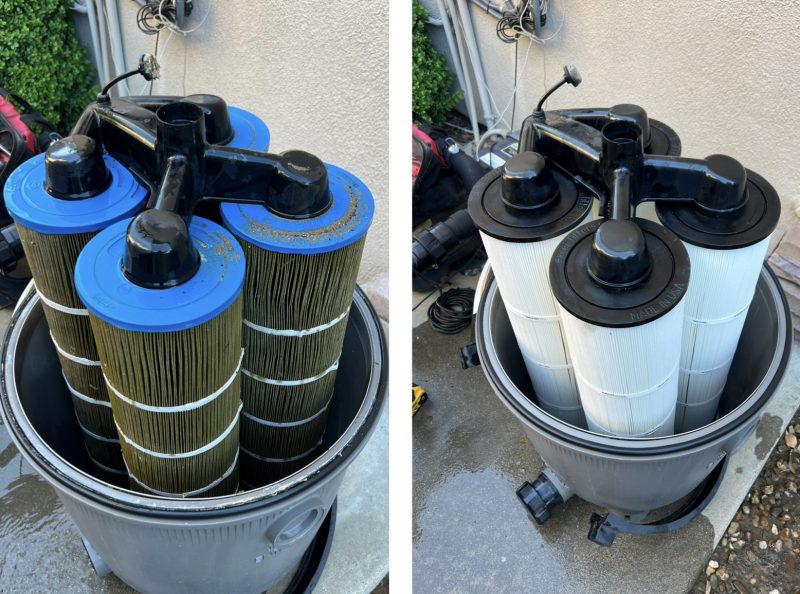
Some failures hide inside the tank. A sand filter sits on a set of slotted laterals that let water through but hold the sand back. If one breaks, sand starts showing up on the pool floor. A DE filter holds its powder on cloth-covered grids, and a tear lets DE blow back into the pool. A cracked manifold, the piece that holds the grids together, sends unfiltered water straight back to the pool. On a cartridge filter, a torn element or a cartridge that isn’t seated on its center pipe does the same thing.
We open the tank, find the broken piece and replace it. If the sand itself is worn out, we’ll tell you, since a pool filter sand change is a separate job.
Pressure That's Too High or Too Low
Your pressure gauge tells the story. Note the reading right after a cleaning or backwash, because that’s your clean starting pressure. Sand and DE filters need a backwash once pressure climbs 8 to 10 psi above that number. Cartridge filters come out for a rinse at about 10 psi over.
If pressure stays high right after a cleaning, something else is wrong. The usual suspects are calcium locked in the media, a blocked return line, a valve left partly closed or dirty DE piled in the bottom of the tank. Chemicals fed ahead of the filter, like tablets dropped in the skimmer, can push pressure up as well.
Low pressure points the other way, toward the suction side. A packed skimmer or pump basket, a clogged suction line or a closed valve before the pump can starve the filter of water. A damaged impeller does the same, and that’s a job for our pool pump repair team.
How Pool Filter Repair Works With Sparkling Clear
Every filter call follows the same steps:
- We turn off the pump and open the air relief valve, so the tank isn’t under pressure when it comes apart
- Your tech checks the gauge, lid, clamp, valve and the plumbing around the filter
- Next, we open the tank and inspect the cartridges, grids, manifold or laterals
- You get a price before any work starts
- Once you approve it, we fix it with manufacturer-approved parts, restart the system and watch the pressure and flow
- If a repair doesn’t make sense, you’ll hear that too, along with your replacement options
Most of the time, we can finish the same or next day, depending on the season.
What Shapes the Price of a Filter Fix
We don’t post repair prices, because the part sets the price. An O-ring, a gauge or an air relief valve is a small part and a short job. On the other hand, grids, a manifold or a set of laterals take more time, since the tank has to come apart, and on a sand filter the sand comes out first. A multiport valve falls in between. Parts for older models can also be harder to find. Either way, you see the number before we start.
Is a Filter Repair the Right Call?
Most filter problems come down to one worn part that we can swap. A repair makes sense when the tank is sound and the trouble is a seal, a valve, a gauge or something inside the tank.
Replacement starts to win when the tank body has a crack, when leaks keep coming back after repairs, or when pressure stays high after a cleaning and the internals check out fine. Age counts as well. Once a filter reaches about 7 to 10 years old, it’s worth pricing both. If a new one wins, our pool filter installation team sizes it to your pump and pool.
Signs Your Filter Needs Repair
Call us when you notice any of these:
- Water pooling under the filter, or dripping from the lid, clamp or valve
- A hiss or spray from the tank seam when the pump starts
- Air bubbles coming out of the return jets
- Sand or DE settling on the pool floor after the pump runs
- Pressure that stays high right after a cleaning or backwash
- A gauge that reads zero while the pump is running
What Filter Repair Doesn't Cover
A few filter jobs fall under other services we offer:
- Routine pool filter cleaning, which our plans include twice a year
- Fresh media when the sand itself is worn out
- A whole new filter when the tank has a crack or is too old to keep fixing
- Pump problems, including a damaged impeller or a motor that won’t start
If we spot one of these during a filter repair, we’ll explain it and price it separately.
Simple Habits That Protect Your Filter
A few small habits help a filter last longer and fail less often:
- Write down your clean starting pressure, then check the gauge every week or so
- Keep a light coat of silicone-based lubricant on the lid O-ring, and skip petroleum products
- Empty the skimmer and pump baskets after storms, since a packed basket restricts flow
- Keep chlorine tablets out of the skimmer basket, because chemicals fed ahead of the filter can raise pressure
- When a hard freeze is coming, keep the pump running so water keeps moving through the filter and pipes
- Call at the first drip or hiss, before the pool level starts to drop
And if the filter quits during a hot week, keep the chlorine up. Some algae can turn a clear pool green in less than a day, so don’t wait on it.
Why McKinney Homeowners Call Sparkling Clear for Filter Repair
Sparkling Clear is family-owned and based right here in McKinney. We’ve worked on pools here for more than ten years, and we cover every McKinney ZIP code. Owner Robert Pierce trains every technician on our routes. In reviews, customers call him Bob, and he still answers the phone.
Filters aren’t electrical, but the pump beside them is. Texas requires a TDLR license for pool electrical work like pumps, heaters, lights and automation. We hold TDLR Residential Appliance Installation Contractor License #1066, and Robert holds installer license #448687. You can check both on the TDLR license search. We’re fully insured, and our Google rating is 5.0.
So if the trouble turns out to be somewhere else on the pad, y’all won’t need a second company. Our pool repairs cover pumps, heaters and spas as well.
How to Start Your Pool Filter Repair
- Call (469) 884-4022 or fill out the form on this page.
- Tell us what you’re seeing, like a drip at the lid, sand in the pool or a high gauge reading.
- We take a quick look at the pool and equipment, then give you a price.
- Once you approve it, we make the repair and test the system.
The quote is free, and there’s no contract to sign.
Pool Filter Repair FAQs for McKinney Homeowners
Straight answers to the questions we hear most about filter repairs. If yours isn’t here, call (469) 884-4022.
Questions About Filter Problems and Repair Costs
Usually one worn part. Calcium scale can clog the media, an O-ring or multiport gasket can wear out, or a lateral, grid or manifold can break. Freeze damage can crack parts, and too much flow wears out cartridges and grids. Sparkling Clear finds the cause and prices the fix first.
Filter leaks usually start at the lid O-ring, a loose clamp, the air relief valve, the drain plug or a worn multiport gasket. Turn the pump off before checking anything, since the tank holds pressure. A crack in the tank body is the one leak that usually calls for a new filter.
It depends on the part. An O-ring, gauge or air relief valve is a small fix. Grids, a manifold, laterals or a multiport valve cost more because the filter comes apart. Sparkling Clear checks the filter first and gives you a firm price before any work starts.
It depends where the crack is. A cracked lid, valve body or manifold is a part swap, priced before we start. A crack in the tank body usually means a pool filter replacement, because the tank holds the pump's full pressure. Sparkling Clear shows you both options.
You can, and with low chlorine it helps hold off algae. Shock works best with water moving, though, so run the pump if the filter isn't leaking or cracked. Without filtration, dead algae and debris stay in the water. Keep swimmers out until free chlorine is 4 ppm or less.
More Filter Repair Questions From McKinney Owners
Usually it's calcium locked in the cartridge or grids, a sand bed blocked with minerals, a partly closed return valve or a blocked return line. Dirty DE in the tank and chemicals fed ahead of the filter raise it, too. If the media is worn out, we'll tell you.
Low pressure usually means the filter isn't getting enough water. Check for a full skimmer or pump basket, a low water level or a closed suction valve. A clogged suction line or damaged impeller can also do it. A gauge reading zero with the pump running may have failed.
Often, yes. Many multiport leaks come from a worn internal gasket or a stem O-ring, which we can swap. A cracked valve body means a new valve. Before you move the handle, turn the pump off and open the air relief valve, since the filter holds pressure.
Yes, as long as the tank is sound. We take the filter apart and check each grid and the manifold for tears or cracks. Then we replace what's damaged. DE in the pool usually points to a torn grid, and unfiltered water can mean a cracked manifold.
Yes. First the sand comes out so we can reach the laterals. We replace the broken ones and check whether high pressure caused the damage. If the old sand is worn out, that's a good time for a pool filter sand change.